
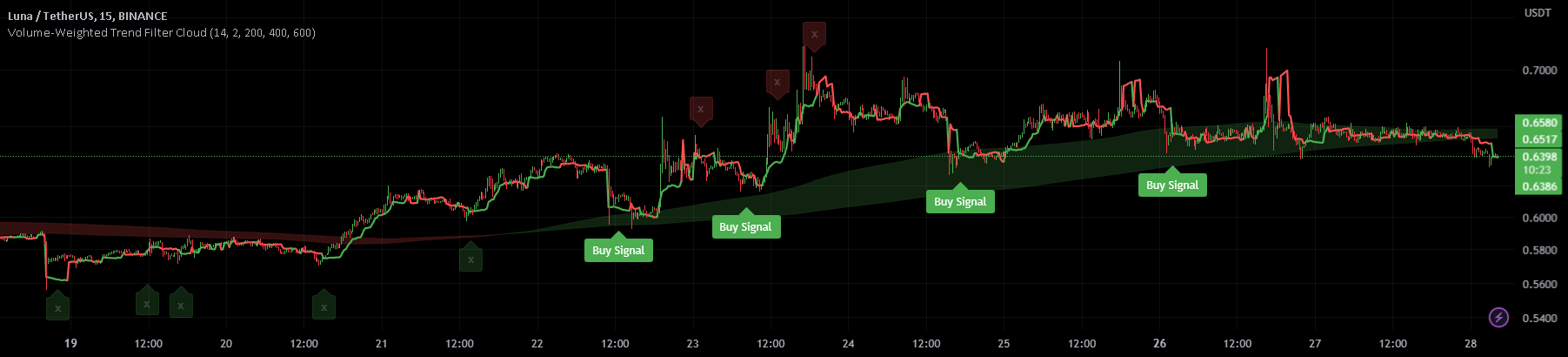
Technical analysis offers a range of strategies built upon mathematical calculations derived from historical price and volume data. Many traders combine various tools to enhance signal accuracy and reduce the likelihood of false readings. This article explores an advanced tactic combining the Supertrend indicator with a volume-weighted filter, aiming to identify high-probability trading opportunities.
Introduction to Supertrend: Volume Weighted Filter Strategy
The Supertrend is a trend-following indicator like Moving Averages and MACD. It plots lines on a price chart indicating the current trend direction. When the price is above the Supertrend line, it signals an upward trend, and when the price is below, it suggests a downward trend. The strength of trend following strategies relies heavily on their reliability. This is where a volume-weighted filter enhances its utility.
Combining Supertrend with volume helps to confirm the strength of a potential trend. Volume often precedes price. If the volume confirms the trend signaled by Supertrend, it adds another layer of validity to the signal.
Section 1: Deconstructing the Supertrend Indicator
The Supertrend indicator calculates its value using the Average True Range (ATR) and a multiplier. The ATR measures market volatility by calculating the average range of price fluctuations over a specified period. This is particularly helpful to filter "noise" from trending assets.
Formula Breakdown:
- ATR: Average True Range is calculated using the following:
- True Range (TR) = Max[(High - Low), abs(High - Previous Close), abs(Low - Previous Close)]
- ATR = (Previous ATR (n-1) + Current TR) / n (where n is the period)
- Basic Upper Band = (High + Low) / 2 + (Multiplier ATR)
- Basic Lower Band = (High + Low) / 2 - (Multiplier ATR)
- Final Upper Band: If Current Basic Upper Band < Previous Final Upper Band OR Previous Close > Previous Final Upper Band then Current Final Upper Band = Current Basic Upper Band else Current Final Upper Band = Previous Final Upper Band
- Final Lower Band: If Current Basic Lower Band > Previous Final Lower Band OR Previous Close < Previous Final Lower Band then Current Final Lower Band = Current Basic Lower Band else Current Final Lower Band = Previous Final Lower Band
- Supertrend: If Previous Supertrend = Previous Final Upper Band AND Current Close <= Current Final Upper Band then Current Supertrend = Current Final Upper Band else If Previous Supertrend = Previous Final Upper Band AND Current Close > Current Final Upper Band then Current Supertrend = Current Final Lower Band else If Previous Supertrend = Previous Final Lower Band AND Current Close >= Current Final Lower Band then Current Supertrend = Current Final Lower Band else Current Supertrend = Current Final Upper Band
The "multiplier" impacts the sensitivity of the Supertrend indicator. A higher multiplier results in a wider band around the price, leading to fewer signals, while a lower multiplier creates a tighter band and more frequent signals. Often, a multiplier of 3 is used as a starting point.
By default, many platforms set the ATR period to 10 or 14. This value signifies the number of periods used to calculate the Average True Range.
Section 2: Introduction to Volume Analysis in Trading
Volume represents the number of shares or contracts traded during a specific period. It is a crucial indicator of market interest and participation.
Significance of Volume:
- Trend Confirmation: Rising prices accompanied by rising volume often indicates a strong uptrend. Conversely, declining prices with rising volume suggest a strong downtrend.
- Reversal Signals: High volume spikes during periods of consolidation or near support/resistance levels can signal potential reversals.
- Breakout Confirmation: Breakouts from chart patterns or key levels are more reliable when accompanied by significant volume.
- Divergence: Volume divergence occurs when price and volume move in opposite directions. For instance, if the price is making new highs, but the volume is declining, it could suggest that the uptrend is losing momentum.
Volume helps assess the conviction behind a price movement. A price increase on low volume may indicate limited interest, while a price increase on high volume implies strong buying pressure.
Section 3: Integrating Volume with the Supertrend
The volume-weighted filter complements the Supertrend by adding a layer of confirmation to its signals. Not all Supertrend signals are created equal. Some may be generated during periods of low market participation, making them less reliable.
Implementing the Volume Filter:
- Identify Supertrend Signal: First, identify potential trading signals generated by the Supertrend indicator. This occurs when the price crosses above the Supertrend line (buy signal) or below the Supertrend line (sell signal).
- Assess Volume: At the time of the signal, analyze the volume. Compare the current volume to its recent average (e.g., the 20-day volume moving average).
- Confirmation Criteria:
- Buy Signal Confirmation: For a buy signal to be valid, the volume on the day of the signal should be above its recent average. This indicates strong buying pressure supporting the upward trend.
- Sell Signal Confirmation: For a sell signal to be valid, the volume on the day of the signal should be above its recent average. This suggests strong selling pressure confirming the downward trend.
- Ignore Weak Signals: If the volume is below average during a Supertrend signal, it suggests weak conviction behind the price movement. Consider these signals less reliable and potentially avoid taking a position.
The volume-weighted filter helps to weed out false signals generated by the Supertrend, improving the overall accuracy and profitability of the strategy.
Section 4: Entry and Exit Strategies
Once a valid Supertrend signal, confirmed by volume, is identified, a clear entry and exit strategy is crucial for managing risk and maximizing potential returns.
Entry Rules:
- Long Entry: Enter a long position when the price crosses above the Supertrend line, and the volume is above its average. A candlestick pattern can add additional confirmation (e.g., bullish engulfing, hammer).
- Short Entry: Enter a short position when the price crosses below the Supertrend line, and the volume is above its average. Bearish candlestick patterns can be used for further confirmation (e.g., bearish engulfing, shooting star).
Stop-Loss Placement:
- Long Position: Place the stop-loss order below a recent swing low or below the Supertrend line itself. The specific placement will depend on the trader's risk tolerance and the volatility of the asset.
- Short Position: Place the stop-loss order above a recent swing high or above the Supertrend line.
Profit Targets:
- Fixed Reward-to-Risk Ratio: Set profit targets based on a predetermined reward-to-risk ratio (e.g., 2:1 or 3:1).
- Technical Levels: Identify potential resistance levels (for long positions) or support levels (for short positions) on the chart. These levels can serve as profit targets.
- Trailing Stop-Loss: Use a trailing stop-loss to lock in profits as the price moves in the favorable direction. This allows you to capture more of the trend while protecting against potential reversals.
The chosen exit strategy will influence the outcome of a trade. It's crucial to base decisions on objective criteria, incorporating both risk management principles and market analysis.
Section 5: Additional Considerations and Refinements
While the Supertrend with volume-weighted filter can be a robust strategy, additional refinements can further improve its performance.
Combining with Other Indicators:
- Moving Averages: Use moving averages to identify the overall trend direction. Only take long positions when the price is above a long-term moving average (e.g., 200-day) and short positions when the price is below the same moving average.
- Relative Strength Index (RSI): Use RSI to identify overbought or oversold conditions. Avoid taking long positions when RSI is above 70 or short positions when RSI is below 30. This helps to filter out signals that may be generated near potential reversal points.
Timeframe Analysis:
- Multi-Timeframe Confirmation: Analyze the Supertrend and volume on multiple timeframes. For instance, if you are trading on a 15-minute chart, check the Supertrend on the 1-hour chart for confirmation of the trend direction.
Market Con
- Avoid Trading During News Events: High-impact news events can cause significant price volatility and invalidate technical signals. It is advisable to avoid trading during these periods.
Backtesting and Optimization:
- Backtesting: Thoroughly backtest the strategy on historical data to assess its performance under different market conditions. This helps to identify potential weaknesses and areas for improvement.
- Parameter Optimization: Experiment with different ATR periods and multipliers in the Supertrend indicator to find the optimal settings for specific assets or market conditions.
Technical analysis tools like the Supertrend indicator and volume, are not foolproof. By incorporating additional filters, considering market context, and continuously refining the strategy through backtesting, traders can improve its effectiveness and increase their chances of success.
Conclusion
The Supertrend indicator, enhanced with a volume-weighted filter, offers a structured approach to identifying and trading trends. The volume confirmation element acts as a risk management tool, helping filter out weaker signals and emphasizing trades backed by stronger market participation. This layered approach, combining trend identification and volume confirmation, provides a more robust framework for trading decisions.
This strategy is most effective in markets exhibiting clear trends. During periods of consolidation or choppy price action, the Supertrend can generate false signals, even with volume confirmation. The inclusion of additional filters, such as moving averages or RSI, can help mitigate these issues.
Before implementing this strategy with real capital, thorough testing is essential. A demo account allows traders to practice the strategy, refine parameters, and develop a strong understanding of its strengths and weaknesses without risking actual funds.
Remember, no trading strategy guarantees profits. Risk management, discipline, and continuous learning are crucial components of successful trading.
🤖 AI-Powered Trading Indicators
Win Up To 93% of Trades With the #1 Most Profitable Indicators
Unlock the power of artificial intelligence and take your trading to the next level. Our VIP Trading Indicators are designed to help you dominate any market — Forex, Crypto, Stocks — with up to 93% accuracy.
Gain instant 24/7 access to 5+ powerful, battle-tested indicators built to predict market trends with precision. Whether you're a beginner or an expert, these tools are optimized for all skill levels and work on any device.
✓ 30-Day Money Back Guarantee — Try Risk-Free!